|
- Biotechnology
- Micromanipulation
- Microscopy
- Quality assurance testing
- Semiconductor testing
- Metrology
- Mass storage device testing
- R&D
- Photonics packaging
|
|
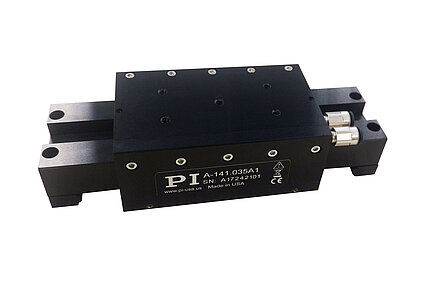
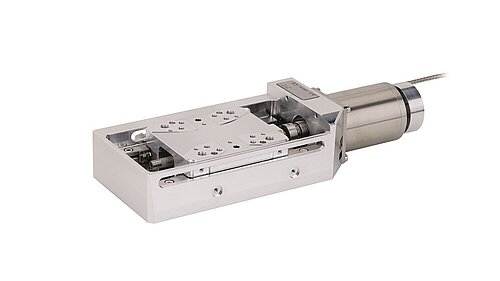
M-661 and M-662 PILine® translation stages offer accelerations to 5 g with millisecond response and velocities to 500 mm/sec in an extremely compact package. Providing travel ranges to 20 mm, they are among the smallest motorized translation stages currently on the market. Both models are designed for open-loop operation (a similar closed-loop stage with linear encoder is available as model M-663. The M-662, with its square footprint, is also suitable for use in XY configurations. For applications where the smallest dimensions are essential, the P-652 micro stage is offered.
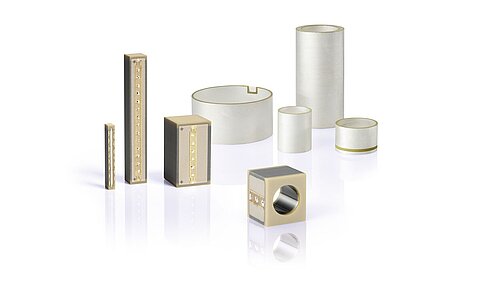
Working Principle PILine® piezo motors use a new, patented, ultrasonic drive developed by PI. A the heart of the system is a piezo ceramic plate, which is excited with high-frequency eigenmode oscillations. A friction tip attached to the plate moves along an inclined linear path at the eigenmode frequency. Through its contact with the friction bar, the moving part of the mechanics drives forward or backwards. With each oscillatory cycle, the mechanics execute a step of a few nanometers; the macroscopic result is smooth motion with a virtually unlimited travel range.
Advantages of PILine® Micropositioning Systems The ultrasonic piezoceramic drives used in PILine® micropositioners have a number of advantages over classical drives:
- Higher Accelerations, up to 5 g
- Speeds up to 500 mm/s
- Small Form Factor
- Self-Locking When Powered Down
- No Shafts, Gears or Other Rotating Parts
- Non-Magnetic and Vacuum-Compatible Drive Principle
Choice of Drive Electronics Special driver electronics are required to create the ultrasonic oscillations for PILine® piezo-motors. The driver controls the motor speed as a function of an analog ±10 V signal. The driver is not included, as it is available in different versions, from the low-priced C-184.161 OEM-board to the C-185.161 bench-top unit. The stage and the driver electronics, however, must be ordered together, so that they can be tuned to one-another for optimum performance.
Notes The products described in this document are in part protected by the following patents:US Pat. No. 6,765,335German Patent No. 10154526
|