|
- Biotechnology
- Micromanipulation
- Microscopy
- Quality assurance testing
- Metrology
- Mass storage device testing
- R&D
- Photonics packaging
|
|
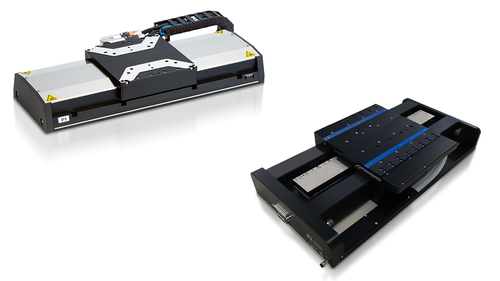
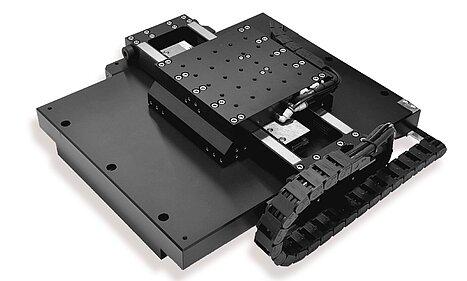
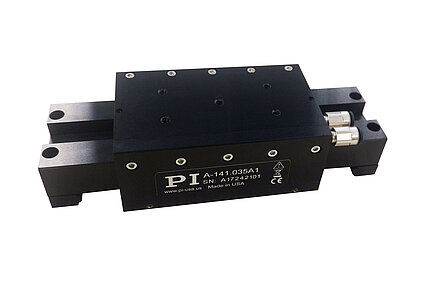
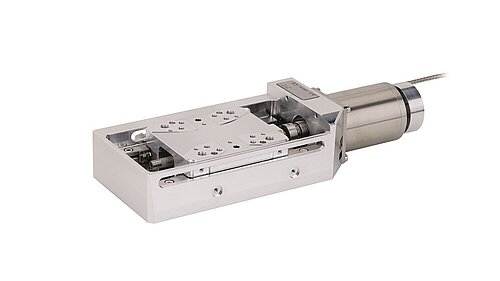
M-664 micropositioning systems are low-profile, high-accuracy translation stages with linear encoders. The M-664 stage is next-larger in the series of piezomotor-driven stages of which the M-663 (see link) is the smallest. For improved guiding accuracy, the M-664 uses two crossed roller bearings mounted on ground aluminum profiles. The integrated P-664 PILine® linear motor can generate forces up to 4 N and maximum closed-loop velocities to 400 mm/s over a 25 mm travel range.
Advantages of PILine® Micropositioning Systems The ultrasonic piezoceramic drives used in PILine® micropositioners have a number of advantages over classical drives:
- Higher Accelerations, up to 5 g
- Speeds up to 500 mm/s
- Small Form Factor
- Self-Locking When Powered Down
- No Shafts, Gears or Other Rotating Parts
- Non-Magnetic and Vacuum-Compatible Drive Principle
Optimized Controller and Drive Electronics PILine® motors require a special drive electronics to generate the ultrasonic oscillations for the piezoceramic element. For optimum performance the highly specialized C-867 motion controller (see link) is recommended. This sophisticated controller also integrates the drive electronics. Furthermore, the controller has a number of special features, including dynamic parameter switching for an optimized high-speed motion and settling behavior to take into account the motion characteristics typical of piezomotors. The broad-band encoder input (50 MHz) supports the outstanding high accelerations and velocities of PILine® drives at high resolutions.
Optionally, for use with third party servo controllers, the C-185 analog drive electronics (stand-alone unit, see link) is available. It controls the motor speed by an analog ±10 V signal. For optimum performance this driver must be tuned together with the stage and should be ordered at the same time as the motor/stage.
Notes The products described in this document are in part protected by the following patents: US Pat. No. 6,765,335 German Patent No. 10154526
|