|
- Scanning interferometry
- Surface structure analysis
- Disk drive testing
- Autofocus systems
- Confocal microscopy
- Biotechnology
- Semiconductor test equipment
|
|
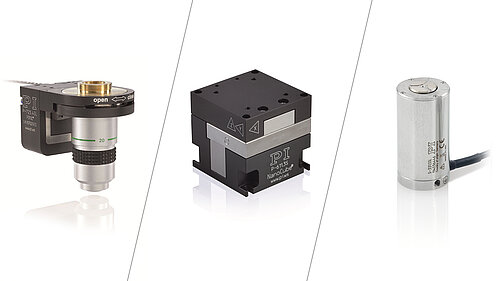
P-720 PIFOCs® are high-speed, piezo-driven microscope objective nanofocusing/scanning devices which can be mounted on most microscopes. The frictionless, flexure guiding system combines high guiding precision for superior focus stability with fast response for rapid settling and scanning. The units are screwed between the turret and the objective, providing a positioning and scanning range of up to 100 µm with sub-nanometer resolution, while extending the optical path by only 13 mm (infinity-corrected microscope required; extension tubes are available to adjust path lengths of other objectives on the turret). The standard thread is W0.8 x 1/36”, for alternate threads see the P-721.CLQ. For larger positioning ranges, to 460 µm, see the P-725, page see link.
Operation The P-720 open-loop PIFOC® is designed for fast, high-resolution positioning and scanning tasks where the absolute position is not important or where an external sensor is used. The vertical position of the objective is roughly proportional to the drive voltage (see p. see link ff. in the “Tutorial: Piezoelectrics in Positioning” section for behavior of open-loop piezos). If absolute position control, high linearity, or repeatability in the nanometer range is required, refer to the P-721 and P-725 closed-loop devices (see pages see link and see link).
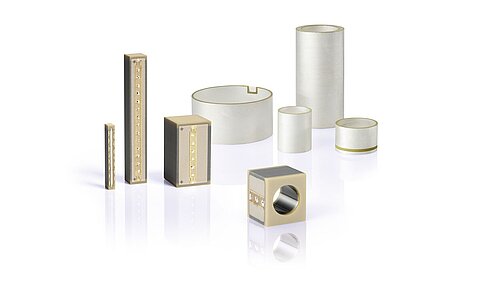
Working Principle / Reliability PIFOCs® are equipped with the award winning PICMA® piezo drives, integrated into a sophisticated flexure guiding system. The wire-EDM-cut flexures are FEA modeled for zero stiction, zero friction and exceptional guiding precision. The ceramic-encapsulated PICMA® drives are more robust than conventional piezo actuators, featuring superior lifetime and performance in both dynamic and static applications.
|
|
Notes See the “Selection Guide” on p. see link ff. for comparison with other nanopositioning systems.
|