|
- 3-D Imaging
- Screening
- Autofocus systems
- Microscopy
- Confocal microscopy
- Surface analysis
- Wafer inspection
|
|
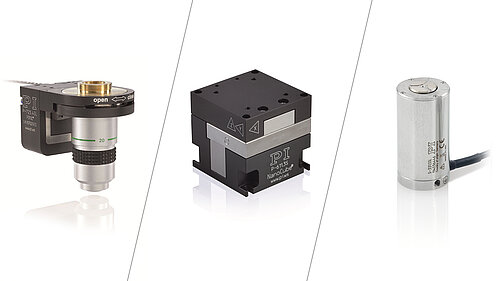
The P-726 PIFOC® Nanofocusing system was developed to achieve the fastest possible stepping time with the heavy, high-numerical-aperture objectives used in many of today's high-resolution microscopy applications. Its extremely stiff design offers excellent settling time and scanning frequency values even when objectives of several hundred grams are moved. High stiffness is achieved with the rotationally symmetric arrangement of multiple piezo drives and the optimized design of the flexure and lever elements, which assure the excellent guiding accuracy and dynamics.
Furthermore, like other members of the PIFOC® family, the P-726 is equipped with direct metrology capacitive position sensors that allow resolutions far below one nanometer.
Direct Metrology with Capacitive Sensors for Highest Stability and Accuracy PI's proprietary capacitive position sensors measure the actual motion of the moving part relative to the stationary base (direct metrology). Errors in the drive train, actuator, lever arm or in guiding system do not influence the measurements. The result is exceptional motion linearity, higher long-term stability and a stiffer, more-responsive servo loop, because external influences are immediately recognized by the sensor. Due to this sensor principle, the P-726 features a resolution of under 0.4 nm in closed-loop and a linearity of 0.02%.
Simple Installation with QuickLock Thread Options The PIFOC® is mounted between the turret and the objective with the QuickLock thread adapter. After threading the adapter into the turret, the QuickLock is affixed in the desired position. Because the PIFOC® body need not to be rotated, cable wind-up is not an issue.
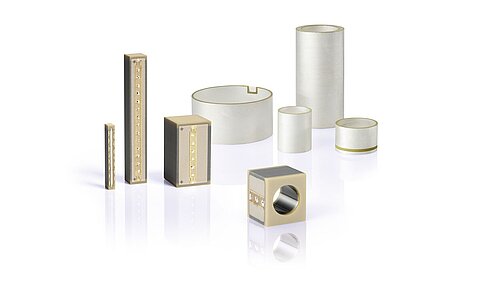
Ceramic Insulated Piezo Actuators Provide Long Lifetime Highest possible reliability is assured by the use of award-winning PICMA® multilayer piezo actuators. PICMA® actuators are the only actuators on the market with ceramic-only insulation, which makes them resistant to ambient humidity and leakage-current failures. They are thus far superior to conventional actuators in reliability and lifetime.
|