|
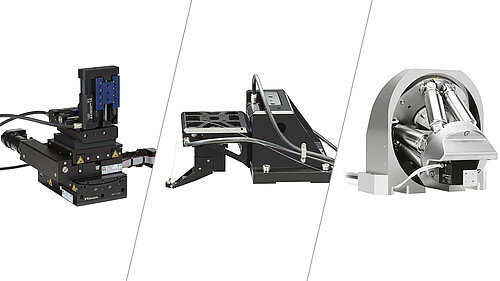
- Scanning microscopy
- Metrology / interferometry
- Semiconductor testing
- Mask/wafer positioning
- Image processing / stablilization
- Biotechnology
- Micromanipulation
- Nanopositioning
|
|
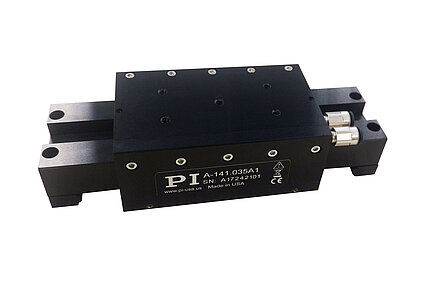
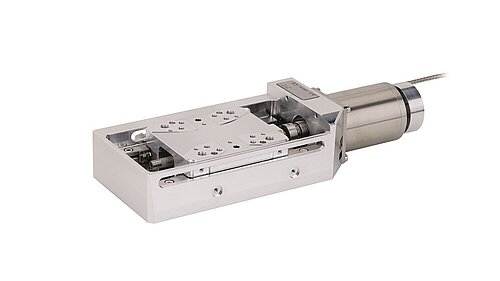
P-734 high-dynamics, XY piezo nanopositioning stages feature linear travel ranges to 100 x 100 µm with sub-nanometer resolution and maximum flatness of motion.
Flatness in the Low Nanometer Range P-734 open-frame XY nanopositioning and scanning stages are ideal for nanometrology tasks that require extreme flatness of scanning. These stages feature an ultra-precise, flexure guiding system which confines motion to the XY plane and reduces runout in Z to a few nanometers or less. This unsurpassed trajectory precision is fundamental for highest-precision surface metrology applications. These stages provide a positioning and scanning range of 100 x 100 µm with accuracy and resolution in the nanometer and sub-nanometer range.
Excellent Guiding Accuracy Flexures optimized with Finite Element Analysis (FEA) are used to guide the stage. FEA techniques are used to give the design the highest possible stiffness in, and perpendicular to, the direction of motion, and to minimize linear and angular runout. Flexures allow extremely high-precision motion, no matter how minute, as they are completely free of play and friction.
Higher Precision in Periodic Motion The highest dynamic accuracy in scanning applications is made possible by the DDL algorithm, which is available in PI"s modern digital controllers. DDL eliminates tracking errors, improving dynamic linearity and usable bandwidth by up to three orders of magnitude!
Direct Position Measurement with Sub-Nanometer Accuracy PI"s proprietary capacitive sensors measure position directly and without physical contact. They are free of friction and hysteresis, a fact which, in combination with the positioning resolution of well under 1 nm, makes it possible to achieve very high levels of linearity. A further advantage of direct metrology with capacitive sensors is the high phase fidelity and the high bandwidth of up to 10 kHz.
Parallel Kinematics and Metrology with Capacitive Sensors for High Trajectory Fidelity In a parallel kinematics multi-axis system, all actuators act directly on one moving platform. This means that all axes move the same minimized mass and can be designed with identical dynamic properties. Systems with parallel kinematics and metrology have additional advantages over serially stacked or nested systems, including more-compact construction and no cumulative error from the different axes. Parallel kinematics systems can be operated with up to six degrees of freedom with low inertia and excellent dynamic performance. Multi-axis nanopositioning systems equipped with both parallel kinematics and parallel, direct metrology are able to measure platform position in all degrees of freedom against one common fixed reference. In such systems, undesirable motion from one actuator in the direction of another (cross talk) is detected immediately and actively compensated by the servo-loops. This Active Trajectory Control Concept can keep deviation from a trajectory to under a few nanometers, even in dynamic operation.
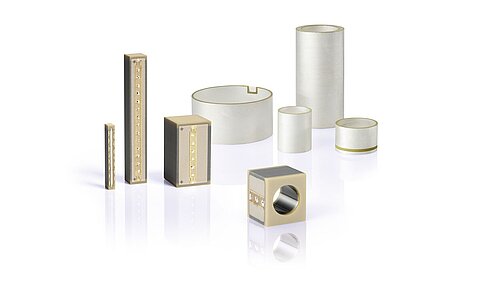
Ceramic Insulated Piezo Actuators Provide Long Lifetime Highest possible reliability is assured by the use of award-winning PICMA® multilayer piezo actuators. PICMA® actuators are the only actuators on the market with ceramic-only insulation, which makes them resistant to ambient humidity and leakage-current failures. They are thus far superior to conventional actuators in reliability and lifetime.
|