|
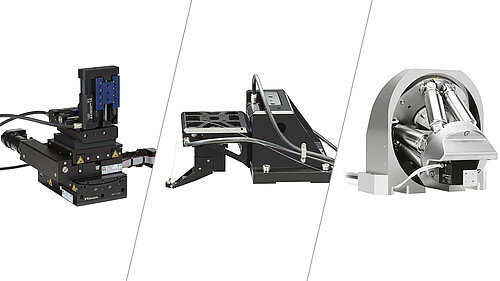
- Laser technology
- Scanning microscopy
- Mask / wafer positioning
- Interferometry
- Metrology
- Biotechnology
- Micromanipulation
|
|
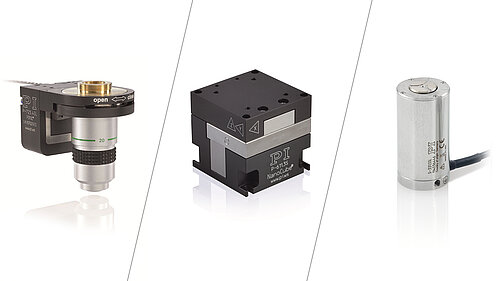
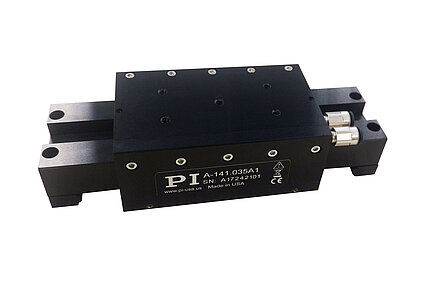
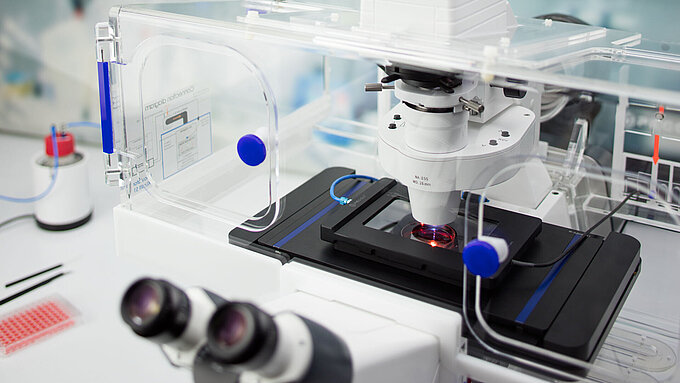
Low Profile, Optimized forMicroscopy Applications P-541/P-542 nanopositioning and scanning stages are designed for easy integration into high-resolution microscopes. They feature a very low profile of 16.5 mm, a large 80 x 80 mm aperture, and offer highly accurate motion with sub-nanometer resolution. A variety of Z stages and Z-tip/tilt stages with the same footprint are also offered to suit a wide range of applications (see link). They are ideal for alignment, nano-focusing or metrology tasks.
Choice of Drives: Long Range or High-Speed Direct Drive Lever-amplified XY systems with 100 and 200 µm travel and direct-driven XY scanners with 45 µm travel are available. Their high resonant frequencies of 1.5 kHz in both axes allow for faster step response and higher scanning rates, needed for example in single-molecule microscopy, or in other time-critical applications.
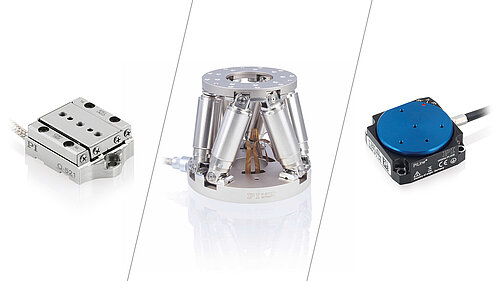
Parallel Kinematics for Fast Response In a parallel kinematics multi-axis system, all actuators act directly on one moving platform. This means that all axes move the same minimized mass and can be designed with identical dynamic properties. Systems with parallel kinematics and metrology have additional advantages over serially stacked or nested systems, including more-compact construction and no cumulative error from the different axes. Parallel kinematics systems can be operated with up to six degrees of freedom with low inertia and excellent dynamic performance. Multi-axis nanopositioning systems equipped with both parallel kinematics and parallel, direct metrology are able to measure platform position in all degrees of freedom against one common fixed reference. In such systems, undesirable motion from one actuator in the direction of another (cross talk) is detected immediately and actively compensated by the servo-loops.
Tailored Position Measurement Integrated high-resolution position sensors provide fast response and positional stability in the nanometer range. Top-of-the-line models use capacitive sensors. They measure displacement directly and without physical contact (direct metrology)enabling superior linearity.
Alternatively, versions with cost-effective strain gauge sensors (SGS) are also available.
|