|
- Scanning microscopy
- Mask/wafer positioning
- Interferometry
- Metrology
- Biotechnology
- Micromanipulation
|
|
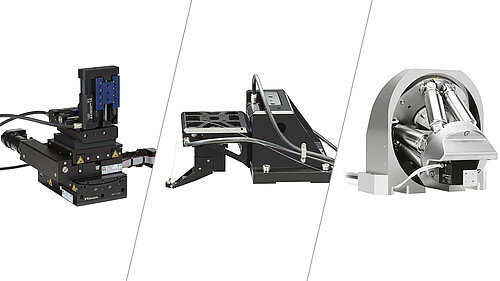
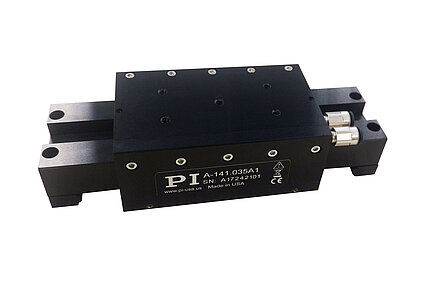
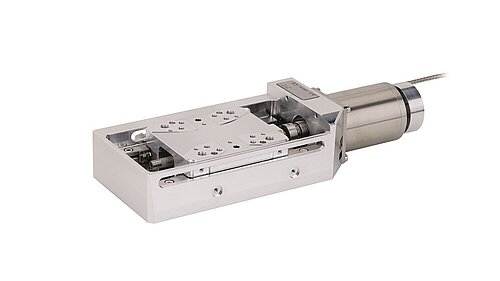
PIMars open-frame piezo stages are fast and highly accurate multi-axis scanning and nanopositioning systems with flatness and straightness in the nanometer range.
The 66 x 66 mm clear aperture is ideal for transmitted-light applications such as near-field scanning or confocal microscopy and mask positioning.
Large Variety of Models PIMars multi-axis nanopositioners are offered in a large variety of configurations. Standard models include long-travel systems (to 300 x 300 x 300 µm), high-speed and vacuum versions. Custom six-axis designs with rotation to 6 mrad are available on request.
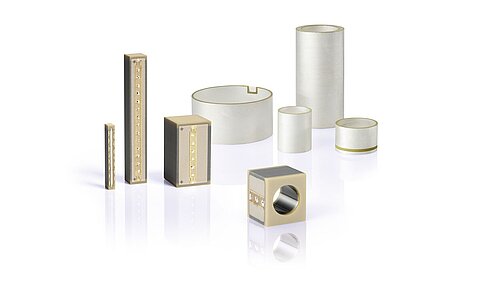
PI offers versions specially designed for applications in ultra-high vacuum with vacuum-qualified components only. The integrated ceramic-encapsulated PICMA® actuators allow high bakeout temperatures and assure minimal outgassing rates. A non-magnetizable version is available on request.
Direct Drive for Ultra-Fast Scanning and Positioning The P-561.3DD versions have resonant frequencies to 1.0 kHz, enabling millisecond scanning rates with sub-nanometer resolution.
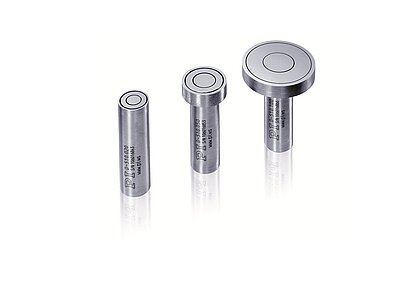
Capacitive Sensors for Highest Accuracy and Position Stability PI"s proprietary capacitive sensors measure position directly and without physical contact. They are free of friction and hysteresis, a fact which, in combination with the positioning resolution of well under 1 nm, makes it possible to achieve very high levels of linearity. A further advantage of direct metrology with capacitive sensors is the high phase fidelity and the high bandwidth of up to 10 kHz.
Active and Passive Guidance for Nanometer Flatness and Straightness Wire-cut flexures optimized with Finite Element Analysis (FEA) are used to guide the stage. The FEA techniques give the design the highest possible stiffness and minimize linear and angular runout. Further enhancement is achieved by active trajectory control: multiaxis nanopositioning systems equipped with parallel metrology are able to measure platform position in all degrees of freedom against a common, fixed reference. In such systems, undesirable motion from one actuator in the direction of another (cross-talk) is detected immediately and actively compensated by the servo-loops. This can keep deviation from a trajectory to under a few nanometers, even in dynamic operation.
|