|
- Fiber positioning
- Semiconductor testing
- Micromachining
- Micromanipulation
- MEMS fabrication/testing
- Photonics / integrated optics
|
|
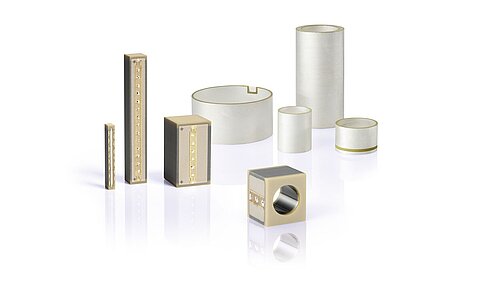
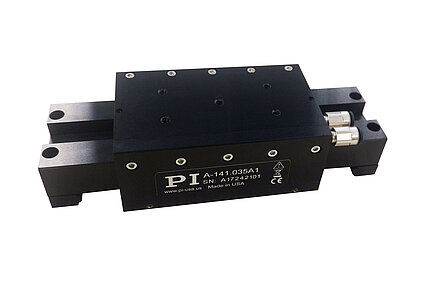
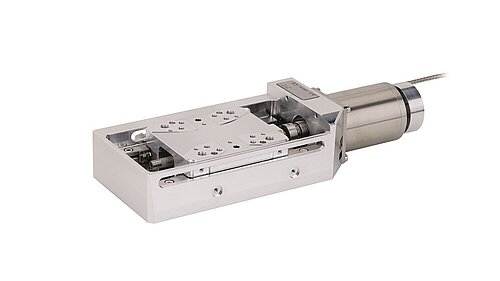
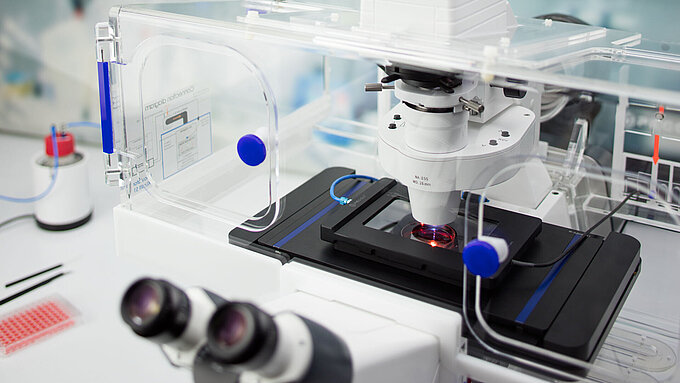
P-611 piezo stages are flexure-guided nanopositioning systems featuring a compact footprint of only 44 x 44 mm. The XY- and XZ-versions described here are part of a family of positioners available in 1 to 3 axis configurations. Despite their small dimensions the systems provide up to 120 µm travel with sub-nanometer resolution. They are ideally suited for planar positioning tasks such as optical-path length correction in interferometry, sample positioning in microscopy or scanning applications, for autofocus and photonics applications. Both versions are available with 100 µm travel per axis. Equipped with ceramic-encapsulated piezo drives and a stiff, zero-stiction, zero-friction flexure guiding system, all P-611 piezo stages combine millisecond responsiveness with nanometric precision and extreme reliability.
Closed-Loop and Open-Loop Versions High-resolution, fast-responding, strain gauge sensors (SGS) are applied to appropriate locations on the drive train and provide a high-bandwidth, nanometer-precision position feedback signal to the controller. The sensors are connected in a full-bridge configuration to eliminate thermal drift, and assure optimal position stability in the nanometer range.
The open-loop models are ideal for applications where fast response and very high resolution are essential, but absolute positioning is not important. They can also be used when the position is controlled by an external linear position sensor such as an interferometer, a PSD (position sensitive diode), CCD chip / image processing system, or the eyes and hands of an operator.
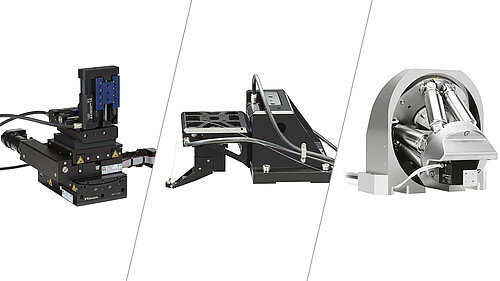
Versatility & Combination with Motorized Stages The P-611 family of piezo stages comprises a variety of single-and multi-axis versions (X, XY, Z, XZ and XYZ) that can be easily combined with a number of very compact manual or motorized micropositioning systems to form coarse/fine positioners with longer travel ranges (see link, see link and see link).
|