|
 |
|
 |
|
Piezo-University |
 |
Fundamentals of Piezoelectricity
|
|
|
|
| Description |
|
Specifications |
|
Downloads |
|
CAD/Video |
|
Material Properties
Notes The following pages give a detailed look at piezo actuator theory and their operation. For basic knowledge read “Quick Facts”, p. see link. For definition of units, dimensions and terms, see “Symbols and Units”, p. see link and “Glossary”, p. see link.
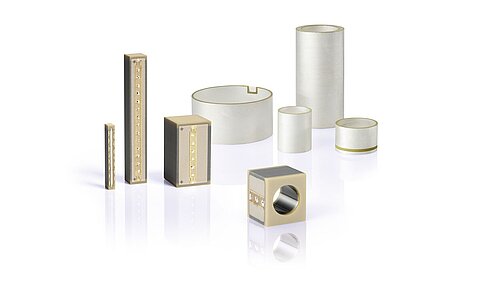
Since the piezo effect exhibited by natural materials such as quartz, tourmaline, Rochelle salt, etc. is very small, polycrystalline ferroelectric ceramic materials such as barium titanate and lead (plumbum) zirconate titanate (PZT) with improved properties have been developed.
PZT ceramics (piezoceramics) are available in many variations and are still the most widely used materials for actuator applications today. Before polarization, PZT crystallites have symmetric cubic unit cells. At temperatures below the Curie temperature, the lattice structure becomes deformed and asymmetric. The unit cells exhibit spontaneous polarization (see Fig. 5), i.e. the individual PZT crystallites are piezoelectric.
Groups of unit cells with the same orientation are called Weiss domains. Because of the random distribution of the domain orientations in the ceramic material no macroscopic piezoelectric behavior is observable. Due to the ferroelectric nature of the material, it is possible to force permanent alignment of the different domains using a strong electric field. This process is called poling (see Fig. 6). Some PZT ceramics must be poled at an elevated temperature. The material now has a remnant polarization (which can be degraded by exceeding the mechanical, thermal and electrical limits of the material). The ceramic now exhibits piezoelectric properties and will change dimensions when an electric potential is applied.
|
|
|
 |
| Drawings & Images: |
| |
 Fig. 5. PZT unit cell: 1) Perovskite-type lead zirconate titanate (PZT) unit cell in the symmetric cubic state above the Curie temperature. 2) Tetragonally distorted unit cell below the Curie temperature.
 Fig. 6. Electric dipoles in domains; (1) unpoled ferroelectric ceramic, (2) during and (3) after poling (piezoelectric ceramic).
|
|
|
|
  |
|