Shopping Basket


Latest PI Newsletter
Fast Low Profile Piezomotor Rotary Stage
High Force Ceramic Linear Motor
24 Bit Piezo Controllers with USB
Ultra-High Dynamics Objective Scanner
PI Nano Microscope Stage
New Vacuum Compatible Products
Miniature Hexapod
Scanning Microscopy Stage

Piezo-University
Actuators and Sensors
Description   Specifications   Downloads   CAD/Video
Drawings & Images   Models/Get Price Quote   Related Info   ?? Questions ??
Metrology for Nanopositioning Systems

There are two basic techniques for determining the position of piezoelectric motion systems: Direct metrology and indirect metrology.

Indirect (Inferred) Metrology
Indirect metrology involves inferring the position of the platform by measuring position or deformation at the actuator or other component in the drive train. Motion inaccuracies which arise between the drive and the platform can not be accounted for.

Direct Metrology
With direct metrology, however, motion is measured at the point of interest; this can be done, for example, with an interferometer or capacitive sensor.
Direct metrology is more accurate and thus better suited to applications which need absolute position measurements. Direct metrology also eliminates phase shifts between the measuring point and the point of interest. This difference is apparent in higher-load, multi-axis dynamic applications.

Parallel and Serial Metrology
In multi-axis positioning sys-tems parallel and serial metrology must also be distinguished.
With parallel metrology, all sensors measure the position of the same moving platform against the same stationary reference. This means that all motion is inside the servo-loop, no matter which actuator caused it (see Active Trajectory Control). Parallel metrology and parallel kinematics can be easily integrated.

With serial metrology the reference plane of one or more sensors is moved by one or more actuators. Because the off-axis motion of any moving reference plane is never measured, it can not be compensated.
See also p. see link ff.


High-Resolution Sensors


Strain Gauge Sensors
SGS sensors are an implementation of inferred metrology and are typically chosen for cost-sensitive applications. An SGS sensor consists of a resistive film bonded to the piezo stack or a guidance element; the film resistance changes when strain occurs. Up to four strain gauges (the actual configuration varies with the actuator construction) form a Wheatstone bridge driven by a DC voltage (5 to 10 V). When the bridge resistance changes, the sensor electronics converts the resulting voltage change into a signal proportional to the displacement.

A special type of SGS is known as a piezoresistive sensor. It has good sensitivity, but mediocre linearity and temperature stability. See also p. see linkff.

Resolution: better than 1 nm (for short travel ranges, up to about 15 µm)

Bandwidth: to 5 kHz

Advantages

  • High Bandwidth
  • Vacuum Compatible
  • Highly Compact


    Other characteristics:
  • Low heat generation (0.01 to 0.05 W sensor excitation power)
  • Long-term position stability depends on adhesive quality
  • Indirect metrology


    Examples
    Most PI LVPZT and HVPZT actuators are available with strain gauge sensors for closed-loop control (see the “Piezo Actuators” section p. see link ff.).

    Note
    The sensor bandwidth for the sensors described here should not be confused with the bandwidth of the piezo mechanics servo-control loop, which is further limited by the electronic and mechanical properties of the system.

    Linear Variable Differential Transformers (LVDTs)
    LVDTs are well suited for direct metrology. A magnetic core, attached to the moving part, determines the amount of magnetic energy induced from the primary windings into the two differential secondary windings (Fig. 15). The carrier frequency is typically 10 kHz.

    Resolution: to 5 nm

    Bandwidth: to 1 kHz

    Repeatability: to 5 nm


    Advantages:

  • Good temperature stability
  • Very good long-term stability
  • Non-contactingK Controls the position of the moving part rather than the position of the piezo stack
  • Cost-effective


    Other characteristics:
  • Outgassing of insulation materials may limit applications in very high vacuum
  • Generates magnetic field


    Examples
    P-780, p. see link; P-721.LLQ, p. 2-20.

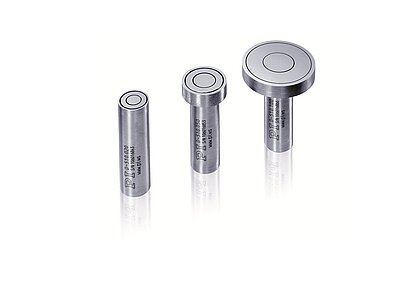
    Capacitive Position Sensors

    Capacitive sensors are the metrology system of choice for the most demanding applications.

    Two-plate capacitive sensors consist of two RF-excited plates that are part of a capacitive bridge (Fig. 17). One plate is fixed, the other plate is connected to the object to be positioned (e.g. the platform of a stage). The distance between the plates is inversely proportional to the capacitance, from which the displacement is calculated. Short-range, two-plate sensors can achieve resolution on the order of picometers. See the “Capacitive Displacement Sensors” section pp. see link ff. for details.

    Resolution: Better than 0.1 nm possible

    Repeatability: Better than 0.1 nm possible

    Bandwidth: Up to 10 kHz

    Advantages:

  • Highest resolution of all commercially available sensors
  • Ideally suited for parallel metrology
  • Non-contacting
  • Excellent long-term stability
  • Excellent frequency response
  • No magnetic field
  • Excellent linearity


    Other characteristics:
  • Ideally suited for integration in flexure guidance systems, which maintain the necessary parallelism of the plates. Residual tip/tilt errors are greatly reduced by the ILS linearization system (see p. see link) developed by PI.

Examples
P-733 parallel kinematic nanopositioning system with parallel metrology, see p. see link.
P-753 LISA NanoAutomation® actuators, see p. see link; additional examples in the “Nanopositioning & Scanning Systems” section.

Drawings & Images:
 
Fig. 13. Strain gauge sensors. Paper clip for size comparison.

Fig. 14. LVDT sensor, coil and core. Paper clip for size comparison.

Fig. 16. Capacitive sensors can attain resolution 10,000 times better than calipers.

Fig. 15. Working principle of an LVDT sensor

Fig. 17. Working principle of two-plate capacitive position sensors


Related Information:
 
D-015 · D-050 · D-100 Capacitive Sensors
Sub-Nanometer-Resolution Position Sensors
 
D-510 PISeca Capacitive Sensors
Single-Plate Sensors with Excellent Position Resolution


© 1996-2010 PI (Physik Instrumente) GmbH & Co. KG. All rights reserved. PI - Moving the NanoWorld. ISO 9001. Specifications subject to change without notice.    nanopositioning Linear Stage PI USA Piezo