Shopping Basket


Latest PI Newsletter
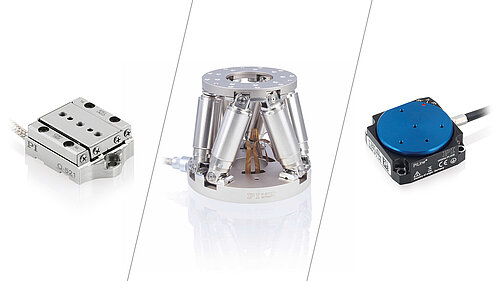
Fast Low Profile Piezomotor Rotary Stage
High Force Ceramic Linear Motor
24 Bit Piezo Controllers with USB
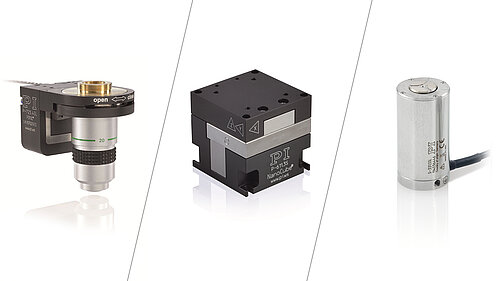
Ultra-High Dynamics Objective Scanner
PI Nano Microscope Stage
New Vacuum Compatible Products
Miniature Hexapod
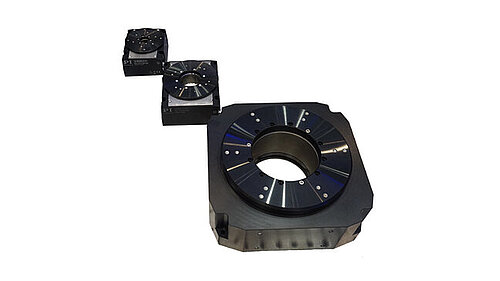
Scanning Microscopy Stage

Piezo-University
Fundamentals of Piezoelectric Actuators
Description   Specifications   Downloads   CAD/Video
Drawings & Images   Models/Get Price Quote   Related Info   ?? Questions ??
Forces and Stiffness

Maximum Applicable Forces (Compressive Load Limit, Tensile Load Limit)
The mechanical strength values of PZT ceramic material (given in the literature) are often confused with the practical long-term load capacity of a piezo actuator. PZT ceramic material can withstand pressures up to 250 MPa (250 x 106 N/m2) without breaking. This value must never be approached in practical applications, however, because depolarization occurs at pressures on the order of 20 % to 30 % of the mechanical limit. For stacked actuators and stages (which are a combination of several materials) additional limitations apply. Parameters such aspect ratio, buckling, interaction at the interfaces, etc. must be considered.

The load capacity data listed for PI actuators are conservative values which allow long lifetime.

Tensile loads of non-preloaded piezo actuators are limited to 5% to 10% of the compressive load limit. PI offers a variety of piezo actuators with internal spring preload for increased tensile load capacity. Preloaded elements are highly recommended for dynamic applications.

The PZT ceramic is especially sensitive to shear forces; they must be intercepted by external measures (flexure guides, etc.).

Stiffness
Actuator stiffness is an important parameter for calculating force generation, resonant frequency, full-system behavior, etc. The stiffness of a solid body depends on Young’s modulus of the material. Stiffness is normally expressed in terms of the spring constant kT, which describes the deformation of the body in response to an external force.

This narrow definition is of limited application for piezoceramics because the cases of static, dynamic, large-signal and small-signal operation with open and shorted electrodes must all be distinguished. The poling process of piezoceramics leaves a remnant strain in the material which depends on the magnitude of polarization. The polarization is affected by both the applied voltage and external forces. When an external force is applied to poled piezoceramics, the dimensional change depends on the stiffness of the ceramic material and the change of the remnant strain (caused by the polarization change). The equation DLN = F/kT is only valid for small forces and small-signal conditions. For larger forces, an additional term, describing the influence of the polarization changes, must be superimposed on the stiffness (kT).
Since piezo ceramics are active materials, they produce an electrical response (charge) when mechanically stressed (e.g. in dynamic operation). If the electric charge cannot be drained from the PZT ceramics, it generates a counterforce opposing the mechanical stress. This is why a piezo element with open electrodes appears stiffer than one with shorted electrodes. Common voltage amplifiers with their low output impedances look like a short circuit to a piezo actuator.

Mechanical stressing of piezo actuators with open electrodes, e.g. open wire leads, should be avoided, because the resulting induced voltage might damage the stack electrically.

Note
There is no international standard for measuring piezo actuator stiffness. Therefore stiffness data from different manufacturers cannot be compared without additional information.

Force Generation
In most applications, piezo actuators are used to produce displacement. If used in a restraint, they can be used to generate forces, e.g. for stamping. Force generation is always coupled with a reduction in displacement. The maximum force (blocked force) a piezo actuator can generate depends on its stiffness and maximum displacement (see also p. see link). At maximum force generation, displacement drops to zero.

(Equation 3)


Maximum force that can be generated in an infinitely rigid restraint (infinite spring constant).

Where:

DL0 = max. nominal displacement without external force or restraint [m]
kT = piezo actuator stiffness [N/m]

In actual applications the spring constant of the load can be larger or smaller than the piezo spring constant. The force generated by the piezo actuator is:

(Equation 4)


Effective force a piezo actuator can generate in a yielding restraint

Where:

DL0 = max. nominal displacement without external force or restraint [m]
kT = piezo actuator stiffness [N/m]
kS = stiffness of external spring [N/m]

Example
What is the force generation of a piezo actuator with nominal displacement of 30 µm and stiffness of 200 N/µm? The piezo actuator can produce a maximum force of 30 µm x 200 N/µm = 6000 N When force generation is maximum, displacement is zero and vice versa (see Fig. 19 for details).

Example
A piezo actuator is to be used in a nano imprint application. At rest (zero position) the distance between the piezo actuator tip and the material is 30 microns (given by mechanical system tolerances). A force of 500 N is required to emboss the material.

Q: Can a 60 µm actuator with a stiffness of 100 N/µm be used?

A: Under ideal conditions this actuator can generate a force of 30 x 100 N = 3000 N (30 microns are lost motion due to the distance between the sheet and the piezo actuator tip). In practice the force generation depends on the stiffness of the metal and the support. If the support were a soft material, with a stiffness of 10 N/µm, the piezo actuator could only generate a force of 300 N onto the metal when operated at maximum drive voltage. If the support were stiff but the material to be embossed itself were very soft it would yield and the piezo actuator still could not generate the required force. If both the support and the metal were stiff enough, but the piezo actuator mount was too soft, the force generated by the piezo would push the actuator away from the material to be embossed.

The situation is similar to lifting a car with a jack. If the ground (or the car’s body) is too soft, the jack will run out of travel before it generates enough force to lift the wheels off the ground.


Displacement and External Forces


Like any other actuator, a piezo actuator is compressed when a force is applied. Two cases must be considered when operating a piezo actuator with a load:

a) The load remains constant during the motion process.

b) The load changes during the motion process.

Note
To keep down the loss of travel, the stiffness of the preload spring should be under 1/10 that of the piezo actuator stiffness. If the preload stiffness were equal to the piezo actuator stiffness, the travel would be reduced by 50 %. For primarily dynamic applications, the resonant frequency of the preload must be above that of the piezo actuator.


a) Constant Force

Zero-point is offset
A mass is installed on the piezo actuator which applies a force F = M · g (M is the mass, g the acceleration due to gravity).
The zero-point will be shifted by DLN » F/kT, where kT is the stiffness of the actuator.
If this force is below the specified load limit (see product technical data), full displacement can be obtained at full operating voltage (see Fig. 20).

(Equation 5)


Zero-point offset with constant force

Where:

DLN = zero-point offset [m]
F = force (mass x acceleration due to gravity) [N]
kT = piezo actuator stiffness [N/m]

Example
How large is the zero-point offset of a 30 µm piezo actuator with a stiffness of 100 N/µm if a load of 20 kg is applied, and what is the maximum displacement with this load?

The load of 20 kg generates a force of 20 kg x 9.81 m/s2 = 196 N. With a stiffness of 100 N/µm, the piezo actuator is compressed slightly less than 2 µm. The maximum displacement of 30 µm is not reduced by this constant force.

b) Changing Force

Displacement is reduced
For piezo actuator operation against an elastic load different rules apply. Part of the displacement generated by the piezo effect is lost due to the elasticity of the piezo element (Fig. 21). The total available displacement can be related to the spring stiffness by the following equations:

(Equation 6)


Maximum displacement of a piezo actuator acting against a spring load.

(Equation 7)


Maximum loss of displacement due to external spring force. In the case where the restraint is infinitely rigid (ks = ∞), the piezo actuator can produce no displacement but acts only as a force generator.

Where:

DL = displacement with external spring load [m]
DL0 = nominal displacement without external force or restraint [m]
DLR = lost displacement caused by the external spring [m]
ks = spring stiffness [N/m]
kT = piezo actuator stiffness [N/m]

Example
Q: What is the maximum displacement of a 15 µm piezo translator with a stiffness of 50 N/µm, mounted in an elastic restraint with a spring constant kS (stiffness) of 100 N/µm?

A: Equation 6 shows that the displacement is reduced in an elastic restraint. The spring constant of the external restraint is twice the value of the piezo translator. The achievable displacement is therefore limited to 5 µm (1/3 of the nominal travel).

Drawings & Images:
 
Fig. 18. Quasi-static characteristic mechanical stress/strain curves for piezo ceramic actuators and the derived stiffness values. Curve 1 is with the nominal operating voltage on the electrodes, Curve 2 is with the electrodes shorted (showing ceramics after depolarization)

Fig. 19. Force generation vs. displacement of a piezo actuator (displacement 30 µm, stiffness 200 N/µm). Stiffness at various operating voltages. The points where the dashed lines (external spring curves) intersect the piezo actuator force/displacement curves determine the force and displacement for a given setup with an external spring. The stiffer the external spring (flatter dashed line), the less the displacement and the greater the force generated by the actuator. Maximum work can be done when the stiffness of the piezo actuator and external spring are identical.

Fig. 20. Case a: Zero-point offset with constant force.

Fig. 21. Case b: Effective displacement of a piezo actuator acting against a spring load.


Related Information:
 
P-007 – P-056 PICA™ Stack Actuator
Piezo actuator for highly dynamic applications


© 1996-2010 PI (Physik Instrumente) GmbH & Co. KG. All rights reserved. PI - Moving the NanoWorld. ISO 9001. Specifications subject to change without notice.    nanopositioning Linear Stage PI USA Piezo