|
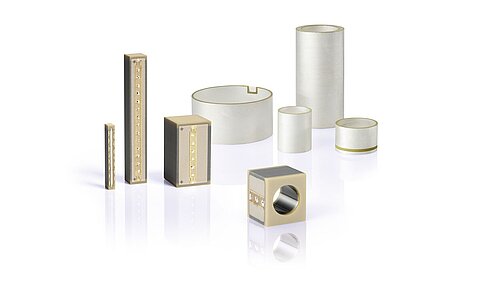
Stack Design (Translators) The active part of the positioning element consists of a stack of ceramic disks separated by thin metallic electrodes. The maximum operating voltage is proportional to the thickness of the disks. Most high-voltage actuators consist of ceramic layers measuring 0.4 to 1 mm in thickness. In low-voltage stack actuators, the layers are from 25 to 100 µm in thickness and are cofired with the electrodes to form a monolithic unit.
Stack elements can withstand high pressures and exhibit the highest stiffness of all piezo actuator designs. Standard designs which can withstand pressures of up to 100 kN are available, and preloaded actuators can also be operated in push-pull mode. For further information see “Maximum Applicable Forces”, p. see link.
Displacement of a piezo stack actuator can be estimated by the following equation:
(Equation 24)

where:
DL = displacement [m]
d33 = strain coefficient (field and displacement in polarization direction) [m/V]
n = number of ceramic layers
U = operating voltage [V]
Example: P-845, p. see link, etc. (see the “Piezo Actuators” section)
Laminar Design (Contraction-Type Actuators) The active material in the laminar actuators consists of thin, laminated ceramic strips. The displacement exploited in these devices is that perpendicular to the direction of polarization and electric field application. When the voltage is increased, the strip contracts. The piezo strain coefficient d31 (negative!) describes the relative change in length. Its absolute value is on the order of 50 % of d33.
The maximum travel is a function of the length of the strips, while the number of strips arranged in parallel determines the stiffness and force generation of the element.
Displacement of a piezo contraction actuator can be estimated by the following equation:
(Equation 25)

where:
DL = displacement [m]
d31 = strain coefficient (displacement normal to polarization direction) [m/V]
L = length of the piezoceramics in the electric field direction [m]
U = operating voltage [V]
d = thickness of one ceramic layer [m]
Examples: Laminar piezos are used in the P-280 and P-282 nanopositioning systems, (see pp. see link and see link).
Tube Design Monolithic ceramic tubes are yet another form of piezo actuator. Tubes are silvered inside and out and operate on the transversal piezo effect. When an electric voltage is applied between the outer and inner diameter of a thin-walled tube, the tube contracts axially and radially. Axial contraction can be estimated by the following equation:
(Equation 26 a)

where:
d31 = strain coefficient (displacement normal to polarization direction) [m/V] L = length of the piezo ceramic tube [m] U = operating voltage [V] d = wall thickness [m]
The radial displacement is the result of the superposition of increase in wall thickness (Equation 26 b) and the tangential contraction:
(Equation 26 b)

r = tube radius
(Equation 26 c)

where:
Dd = change in wall thickness [m] d33 = strain coefficient (field and displacement in polarization direction) [m/V] U = operating voltage [V]
When the outside electrode of a tube is separated into four 90° segments, placing differential drive voltages ±U on opposing electrodes will lead to bending of one end. Such scanner tubes that flex in X and Y are widely used in scanning-probe microscopes, such as scanning tunneling microscopes.
The scanning range can be estimated as follows:
(Equation 27)

where:
Dx = scan range in X and Y (for symmetrical electrodes) [m] d31 = strain coefficient (displacement normal to polarization direction) [m/V] U = differential operating voltage [V] L = length [m] ID = inside diameter [m] d = wall thickness [m]
Tube actuators cannot generate or withstand large forces. Application examples: Microdosing, nanoliter pumping, scanning microscopy, ink jet printers.
Examples: PT120, PT130, PT140 (p. see link).
|