|
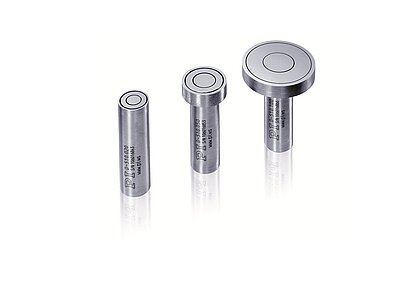
Measurement Method Capacitive position sensors are analog non-contact devices. A two-electrode capacitive position sensor consists of two RF-driven plates that are part of a capacitive bridge. The high-frequency AC excitation provides better long term stability than DC excited sensors (see link, Fig. 5). One plate (probe) is fixed, the other plate (target) is connected to the object to be positioned. Since the plate size and the dielectric medium (air) remains unchanged, capacitance is directly related to the distance between the plates. Ultra-precise electronics convert the capacitance information into a signal proportional to distance.
Direct Metrology, Parallel Metrology The sensors offered by PI are the most accurate measuring systems for nanopositioning applications currently on the market. In contrast to high-resolution sensors measuring deformation in the drive train (see link), like strain gauge or piezoresistive sensors, capacitive sensors are non-contact, direct-metrology devices-a fact which gives them many advantages:
- Better Phase Fidelity
- Higher Bandwidth
- No Periodic Error
- Non-Contacting
- Ideal for Parallel Metrology
- Higher Linearity
- Better Reproducibility
- Higher Long-Term Stability
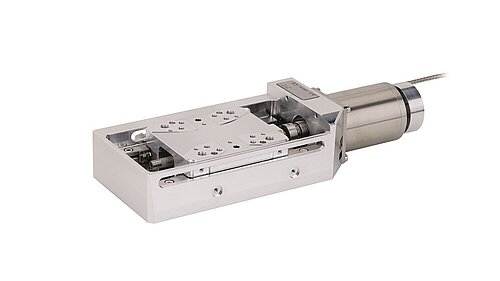
Capacitive sensors are especially well-suited for parallel metrology configurations. In multi-axis nanopositioning systems, parallel metrology means that the controller monitors all controlled degrees of freedom relative to “ground” (the fixed frame) and uses each actuator to compensate the undesired off-axis motion of the others automatically (active trajectory control). As a result, it is possible to keep deviations in the sub-nanometer and sub-microradian range (see link in the “Tutorial” section).
Resolution Resolution on the order of picometers is achievable with short-range, two-electrode capacitive position sensors (single-electrode capacitive position sensors provide less resolution, linearity and accuracy than two-electrode sensors). Theoretical measurement resolution is limited only by quantum noise. In practical applications, stray radiation, electronics-induced noise and geometric effects are the limiting factors. For example, with the 100 µm range, a D-100.00 sensor and E-509.C1A electronics, the effective noise factor is 0.02 nm/EDDHz. This translates to 0.2 nm at 100 Hz bandwidth. The maximum standard bandwidth (jumper selectable) is 3 kHz. Figure 2 shows a D-015, 15 µm capacitive position sensor and an interferometer, both measuring nanometer-range actuator cycles. The graphs clearly show the superior resolution of the capacitive position sensing technique.
Notes In addition to the standard sensors listed here, PI offers a variety of custom versions along with custom electronics for different measuring ranges, material match etc. If you don’t find what you are looking for, please call your local PI Sales Engineer.
|