Shopping Basket


Latest PI Newsletter
Fast Low Profile Piezomotor Rotary Stage
High Force Ceramic Linear Motor
24 Bit Piezo Controllers with USB
Ultra-High Dynamics Objective Scanner
PI Nano Microscope Stage
New Vacuum Compatible Products
Miniature Hexapod
Scanning Microscopy Stage

Operating Characteristics of Piezo Amplifiers
Description   Specifications   Downloads   CAD/Video
Drawings & Images   Models/Get Price Quote   Related Info   ?? Questions ??
 
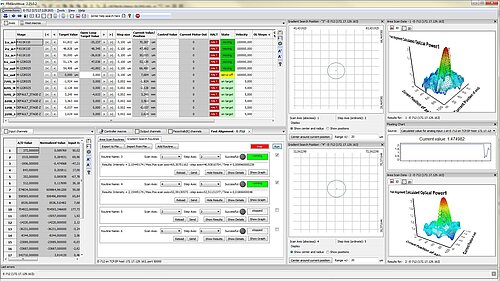
Software Overview
 
Power Requirements for Piezo(PZT) Operation
The operating limits of a piezo amplifier depend on the amplifier power, the amplifier design, and of course, the piezo’s electrical capacitance. For dynamic applications, PZTs require high charge and discharge currents. Those requirements are best met by power amplifiers that can source and sink high peak currents. The average current is of secondary importance. For exact information on maximum operating frequency with a given PZT load refer to the individual operating limits graphs.
Open-loop operating limits data for all PI piezo power amplifiers in this catalog were taken after 15 minutes of continuous operation (PZT and amplifier) at room temperature. At power up, (cold conditions) maximum operating frequency is higher.

The indicated capacitance values are small-signal values for actual piezo actuators (measured at 1 V, 1000 Hz, 20 °C, no load). The capacitance of piezo ceramics changes significantly with amplitude, temperature, and load, up to approximately 200% of the unloaded small-signal capacitance at room temperature. See tutorial "Electrical Fundamentals" (p. 2-195) for more information.
Therefore the operating limits graphs actually reflect a much higher load to the amplifier than a standard capacitor of the same value would represent.

Adjusting Control Input
In order to achieve minimum distortion of the output waveform, it is important to ensure that the control input amplitude is reduced in proportion to the roll-off of the output voltage at higher frequencies.

Example: The E-503 (E-663) amplifier can drive a 23 ?F load at 100 V peak-to-peak (sinewave) up to approximately 15 Hz. At higher frequencies the output voltage drops off, e. g. to 80 V at 20 Hz. Therefore it would be important to reduce the input voltage amplitude to 8 V (gain = 10) at this frequency. Otherwise the amplifier will output a clipped distorted sinewave.
See "Introduction Flexure Stages" (p. 2-10) for more information on controller selection.

Application-Specific Settings
To achieve optimum performance each position servo-controller must be adjusted for displacement range, frequency response, settling time and optimum match with the position sensor. This adjustment is done at the factory and is included in the price of the controller (see p. 2-187).

To optimize the system settings, additional information about the desired operating bandwidth, the mass to be moved by the piezo and the spring constant of any preload or of the material the piezo pushes against is required.

The position servo-control portion of all analog PI piezo servocontrollers is identical, employing a proportional integral (P-I) algorithm specially optimized for piezo actuators. A differential term is not recommended with piezo actuators because it only increases the noise. One or several notch filters are used to greatly improve dynamics / bandwidth.

High System Bandwidth

All PI nanopositioning controllers (analog and digital) are equipped with one or more user-tunable notch filters. A controller with notch filter can be tuned to provide higher bandwidth because sideeffects of system resonances can be suppressed before they affect system stability. For the most demanding step-and-settle applications, PI’s exclusive Mach™ InputShaping® implementation is available as an option.
Drawings & Images:
 
The diagram shows how the piezo amplifier input range can be varied with the DC-offset potentiometer. This principle is also valid for HVPZT amplifiers, where the typical input range is 0 to +10 V and the output range is 0 to 1000 V. The DC-offset potentiometer allows for continuous shifting of the input range between 0 V to +10 V and -10 V to 0 V.


Related Information:
 
Piezo Actuator Electrical Fundamentals
 
E-831 Piezo Driver
OEM Module, Power Supply for up to 3 Axes
 
E-505 Piezo Amplifier Module
High Power, E-500 Piezo Controller System
 
E-508 PICA™ Piezo Amplifier Module
High-Power Module with 1100 V Output Voltage, E-500 Piezo Controller System


© 1996-2010 PI (Physik Instrumente) GmbH & Co. KG. All rights reserved. PI - Moving the NanoWorld. ISO 9001. Specifications subject to change without notice.    nanopositioning Linear Stage PI USA Piezo