|
- Biotechnology
- Semiconductor technology
- Micromachining
- Micromanipulation
- X-ray diffraction measurements
- Tool control
|
|
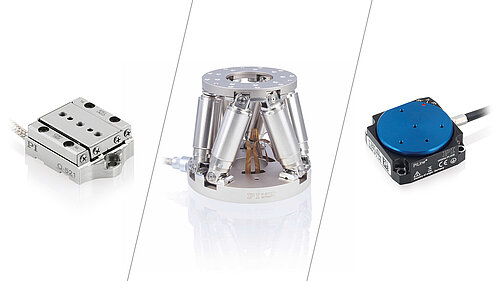
The M-840 is the ideal micropositioning system for all complex positioning tasks which rely on high accuracy and speed in six independent axes. In addition to positioning all axes, it allows the user to define the center of rotation (pivot point) anywhere inside or outside the system envelope by one simple software command.
Fast Positioning in All Six Axes Two models of the M-840 Hexapod are available. The M-840.PD3 Hexapod, which features a higher speed and direct-drive actuators, positions loads of up to 10 kg in horizontal and up to 3 kg in random orientation at up to 50 mm/s and 600 mrad/s with micron accuracy. The DC-motor-version, M-840.DG3, is basically self-locking. It positions loads of up to 30 kg in horizontal and up to 10 kg in random orientation, and offers smallest sub-micron step sizes.
Hexapod vs. Serial Kinematics Systems The Hexapod is driven by six high-resolution actuators all connected directly to the same moving platform. This design provides a high system stiffness and a large clear aperture. Because of the low mass of the moving platform, positioning operations can be performed with far lower settling times than with conventional, stacked multi-axis systems. In such systems, runout, guiding errors, and the friction and inertia of moving cables all accumulate to limit accuracy and repeatabilityproblems which do not affect parallel kinematic systems like the Hexapod.
Fixed Virtual Pivot Point For optics and other alignment tasks, it is important to be able to define a fixed pivot point. The sophisticated Hexapod controller allows choosing any point in space as the pivot point for the rotation axes by software command. The pivot point remains fixed relative to the platform. Target positions in 6-space are entered in user-friendly coordinates and reached by smooth vectorized motion.
Open Architecture Control of the hexapod is facilitated by the controllercontroller's open
interface architecture, which
provides a variety of high-level
commands and includes a macro language for programming and storing command sequences.
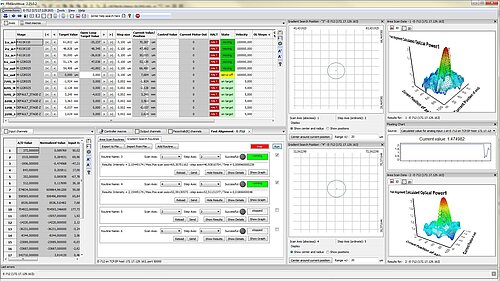
Automatic Optics Alignment With the internal or external photometer option and the integrated scanning routines, just a few commands are needed to perform an automated alignment of optical components. For more information about the photometers see www.pi.ws.
|