|
- Biotechnology
- Semiconductor technology
- Micromachining
- Micromanipulation
- X-ray diffraction measurements
- Tool control
|
|
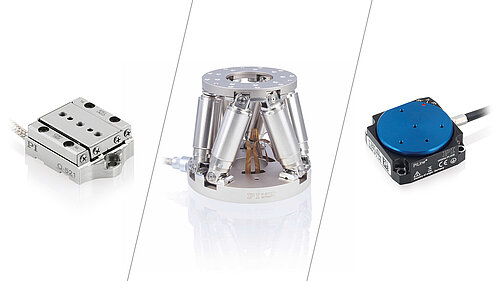
The M-811.STV is PI's smallest standard vacuum-compatible Hexapod. Despite its size it can handle loads up to 5 kg (2.5 kg in any orientation) and achieves velocities up to 10 mm/sec. With a diameter of only 130 mm and a height of 115 mm it provides travel ranges up to 35 mm in the XY-plane and up to 13 mm in the Z-direction. In combination with the large tilting angles of 20° around the X and Y axis and up to 40° around the vertical axis it allows for complex motion profiles with particularly flexible placement of the load – a great advantage in restricted areas (such as beam lines) and small vacuum chambers. Each individual strut has a positioning resolution of 40 nm; multi-axis motion can be accomplished with sub-micron repeatability. In addition to controlling all axes in Cartesian coordinates, a software command allows the user to select the center of rotation (pivot point) freely anywhere inside or outside the system envelope.
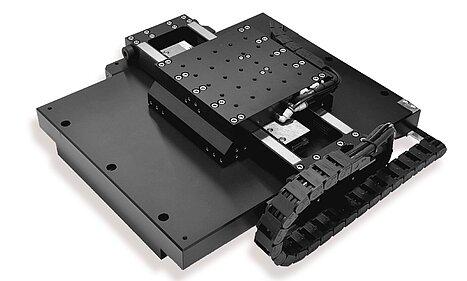
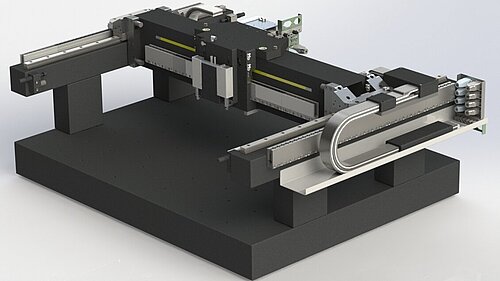
Hexapod vs. Serial Kinematics Systems The Hexapod is driven by six high-resolution actuators all connected directly to the same moving platform. This design provides a high system stiffness and a large clear aperture. Because of the low mass of the moving platform, positioning operations can be performed with far lower settling times than with conventional, stacked multi-axis systems. In such systems, runout, guiding errors, and the friction and inertia of moving cables all accumulate to limit accuracy and repeatability—problems which do not affect parallel kinematic systems like the Hexapod.
Fixed Virtual Pivot Point For optics and other alignment tasks, it is important to be able to define a fixed pivot point. The sophisticated Hexapod controller allows choosing any point in space as the pivot point for the rotation axes by software command. The pivot point remains fixed relative to the platform. Target positions in 6-space are entered in user-friendly coordinates and reached by smooth vectorized motion.
Open Architecture Control of the Hexapod is facilitated by the controller's open interface architecture, which provides a variety of high-level commands and includes a macro language for programming and storing command sequences.
|