|
- Surface Inspection
- Microscopy
- Laser technology
- Interferometry
- Metrology
|
|
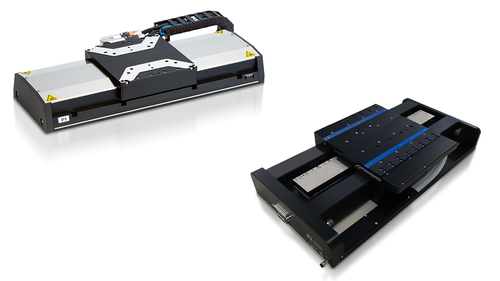
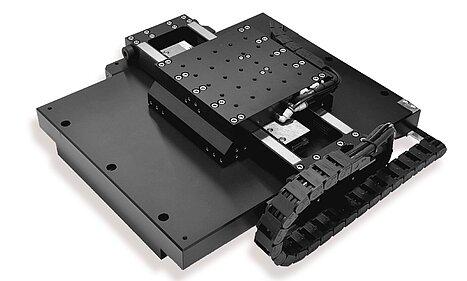
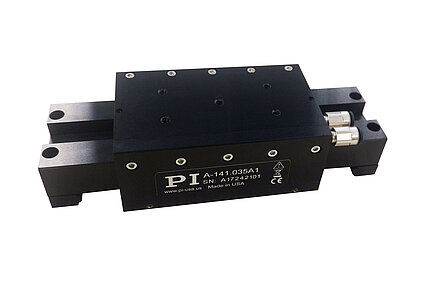
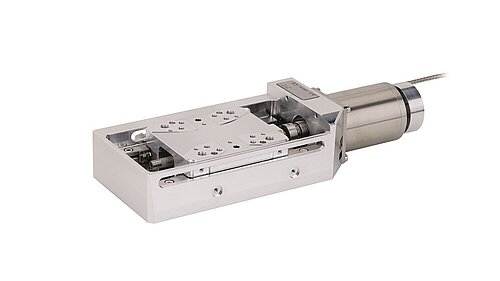
The M-511.HD is an advancement on PI"s proven M-5x1 precision micropositioning stage series. The new hybrid system overcomes the limitations of conventional precision positioning systems by combining the well-known advantages of piezo-flexure-drives (unlimited resolution and very rapid response) with the long travel ranges and high holding forces of a servo-motor/ballscrew arrangement. The M-511.HD allows velocities to 50 mm/s with an encoder resolution of 2 nm and load capacity of 50 kg for horizontal operation.
Long Travel Ranges with Nanometer Precision The challenge of implementing hybrid technology is not only the positioning stage design, but also the use of high-resolution sensors over large travel ranges, the processing of the resulting high-frequency signals and the design of special control algorithms to take full advantage of the hybrid concept.
On the mechanical side, this is accomplished by decoupling the moving platform from the positioner"s motor-ballscrew-drive by frictionless flexures and stiff, highly responsive piezo actuators.
Due to its high stiffness and instantaneous, sub-millisecond range response, the integrated piezo flexure drive provides active stick/slip compensation during startup and settling and is the key to achieving consistent and repeatable nanometer level positioning increments. It also cancels out motion irregularities caused by the ball screw and significantly improves velocity control.
Servo-control of the system employs a single high-resolution position feedback sensor (direct metrology) which means that the inherent piezo precision is available over the entire travel range of 100 mm, and longer travel ranges are basically feasible. The resolution and the positioning accuracy mainly depend on the choice of the feedback sensor.
Hybrid Controller Technology is Key to Success PI"s highly specialized C-702 hybrid nanopositioning controller (see link) compares the actual platform position (by reading the integrated linear encoder) with a calculated, smooth trajectory in real time. Its complex control algorithms continuously actuate both the piezoelectric and servo motor drives in a way to provide the best possible overall performance.
This makes hybrid systems ideal for applications where extremely smooth motion is required, where the position of an incident needs to be read and refound precisely, or where an externally specified target position needs to be hit within few a nanometers, such as in surface inspection or metrology.
|