|
The C-848 is a flexible, multi-purpose, rackmount positioning and motion controller for DC servo-motors. It is designed for general positioning and automation tasks in research and industry.
Flexible Multi-Processor Architecture Based on a dual-processor structure, the C-848 offers the flexibility expected in today´s demanding prototyping and high-precision production environment.
In parallel with the general processor handling communication and macro execution, a fast DSP motion-control chipset is dedicated to trajectory generation and servo-control. In addition to three inputs per channel for limit switches and home position, eight TTL inputs and eight TTL outputs are available for flexible automation.
The C-848 also offers advanced motion control features such as:
- Linear interpolation
- Trajectory generation for trapezoidal and s-curve profiles
- Electronic gearing
- Real-time reference and limit position capture
Integrated Servo-Amplifiers/PWM Output Integrated, low-noise, linear power amplifiers allow operation of any PI micropositioning system without additional external amplifiers, reducing costs and simplifying the setup. In addition to the linear amplifiers, PWM (pulse width modulation) output signals are available to drive PI micropositioning stages equipped with ActiveDrive™ motors. PI General Command Set (GCS) The comprehensive command structure is based on the PI General Command Set (GCS). With GCS the development of custom application programs is simplified, because the commands for all supported devices are identical in syntax and function. PI controllers for nanopositioning systems, for piezomotors and servo or stepper motors can be commanded with GCS.
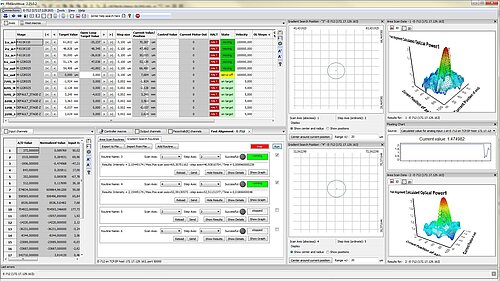
Software / Programming In addition to the user software for setup, system optimization and operation, comprehensive LabView™ and DLL libraries are provided.
Control of the C-848 is provided either through the RS-232 or an optional TCP/IP interface. For manual control, the unit can be operated with a C-819.10 joystick.
The C-848 can also run in stand-alone mode, and a standard computer keyboard and monitor can be connected for direct programming.
|